True Random Number Service
Advisory: We only operate services from the RANDOM.ORG domain. Other sites that claim to be operated by us are impostors. If in doubt, contact us.
Real-Time Statistics
These pages contain real-time and historical statistics that measure various aspects of the true random number generator's operation. All random numbers generated by RANDOM.ORG are subjected to the tests below. The tests originate from several sources, but the majority are recommended by the US National Institute of Standards and Technology (NIST) as discussed on the Statistical Analysis page.
Choose from the tests below or use the very fancy Statistics Browser, which gives you access to all the graphs in one single interface.
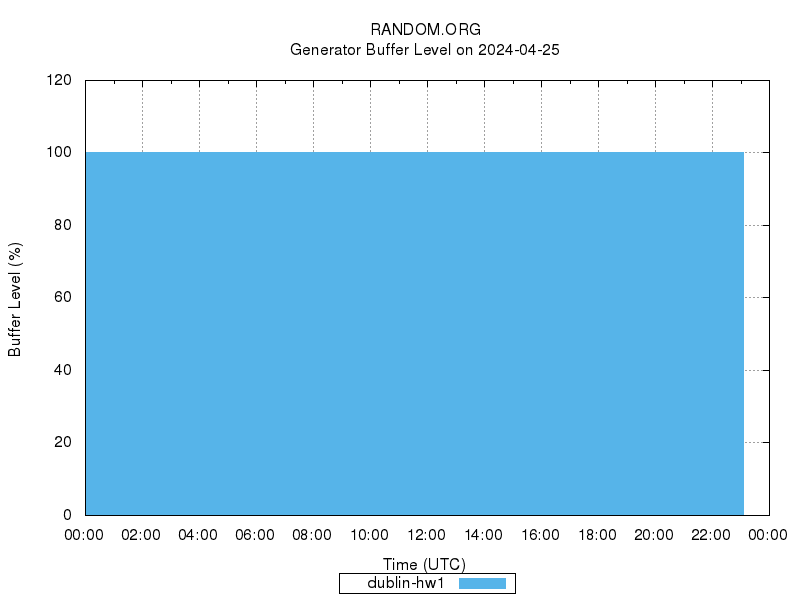 |
Buffer LevelThe buffer level graphs give an indication of how busy the generator is. The generator contains one buffer for each radio, which is constantly filled with randomness generated from that radio. If the buffer level for a given radio is low, it means that radio is busy. [more] |
 |
Source PurityAny source of true randomness may contain skew towards 0 or 1 in the data. The skew is removed by a skew correction algorithm. The source purity graphs show how close to unskewed the random data generated is before skew correction is performed. [more] |
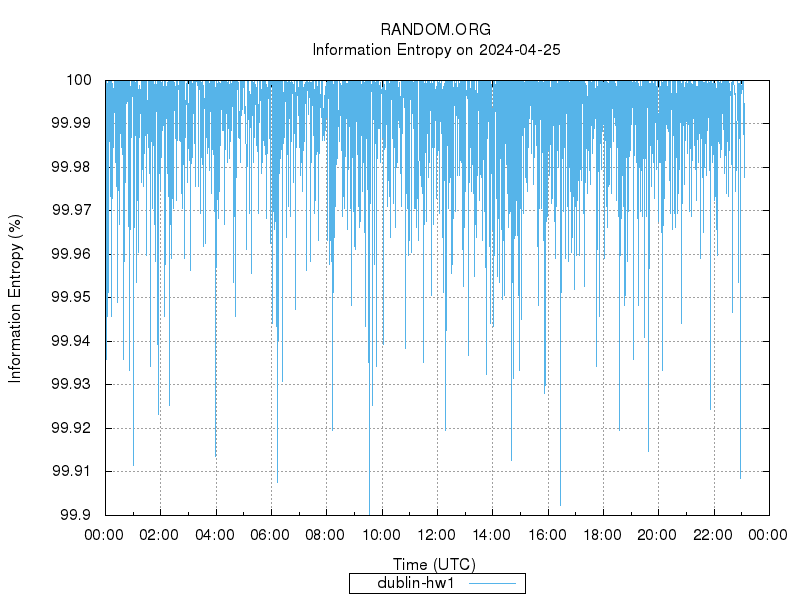 |
Information EntropyThe information entropy graphs show the entropy level in the data as a percentage of the theoretical maximum. Information entropy gives an indication of how difficult it is to predict what the next bit will be based on the bits you have already seen. [more] |
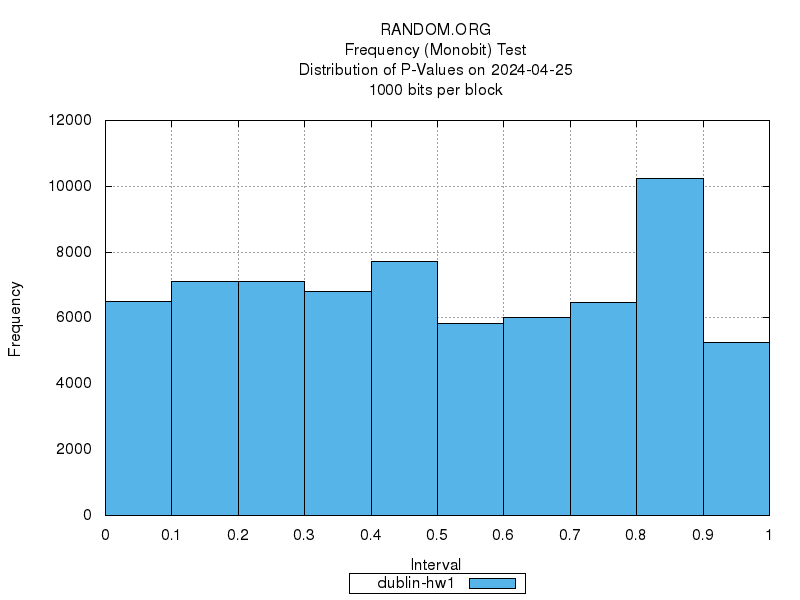 |
Frequency (Monobit) TestThis test is part of the NIST recommendations. The graphs show whether the number of 0s and 1s produced by the generator is as close to 50-50 as you would expect for a truly random sequence. [more] |
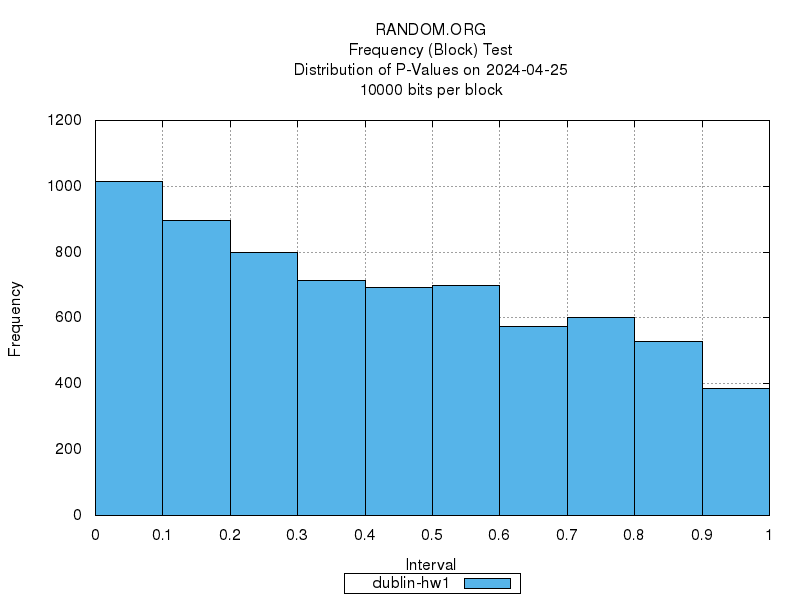 |
Frequency (Block) TestThis test is part of the NIST recommendations. Like the Frequency (Monobit) Test, the graphs for this test show whether the number of 0s and 1s produced by the generator is as close to 50-50 as you would expect for a truly random sequence. [more] |
 |
Runs TestThis test is part of the NIST recommendations. The graphs show whether the number uninterrupted series of ones and zeroes of various lengths are as would be expected for a truly random sequence. [more] |
Note that while the RANDOM.ORG numbers passed a spreadsheet implementation of the entire NIST suite, I am still in the process of implementing the NIST tests such that they are run on all numbers generated. While the Statistical Analysis page gives all the tests, only the ones you see above have been implemented as real-time statistics so far.